Developer Toolv1.0.0
ZeroPort
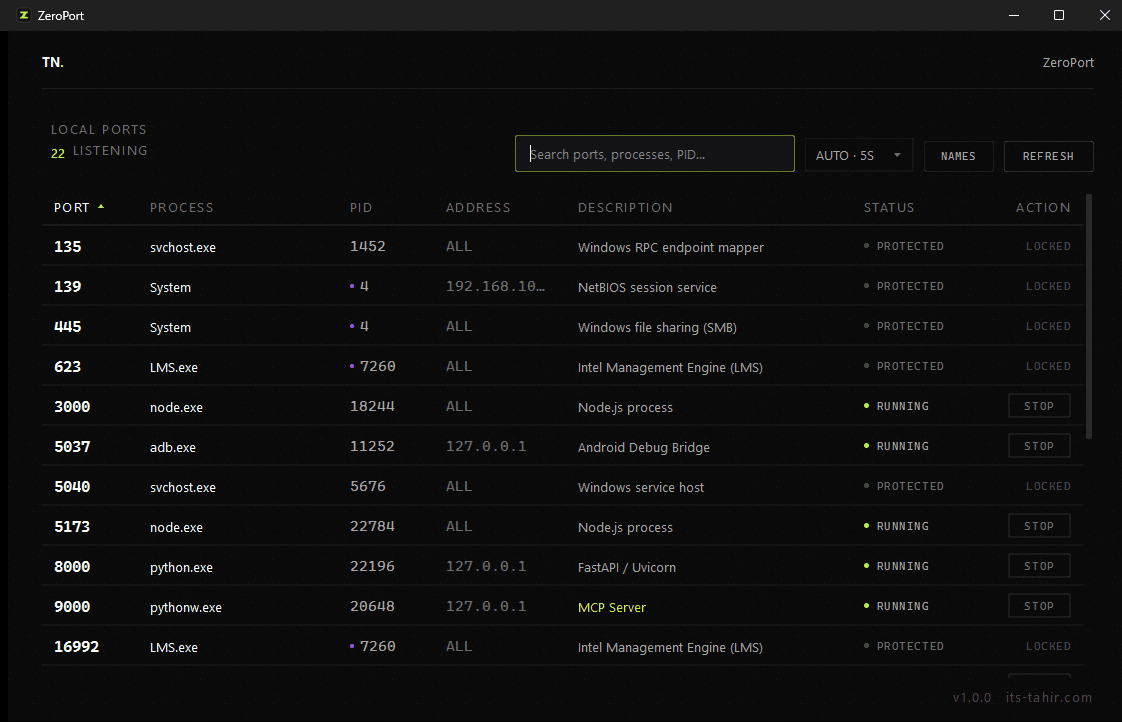
A Windows app that answers one question fast: what is using this port? It lists every listening TCP port, reads the command line to name the real service — FastAPI, Next.js, Postgres — and stops it safely, revalidating process identity before any kill.
How it works
- Replaces the netstat → tasklist → guesswork loop with one window: every listening TCP port, the process that owns it, and a single action to release it.
- Names the real service from the process command line rather than the port number, so "python -m uvicorn main:app" reads as FastAPI / Uvicorn instead of python.exe. The port is consulted last, so a bare python.exe on 5432 never becomes PostgreSQL.
- Termination revalidates PID, start time and executable name immediately before acting, so a recycled PID can never be killed by mistake — and a process it cannot verify is marked un-stoppable rather than offered a stop button.
- Sockets bound to both IPv4 and IPv6 collapse into one row per port and process: a real scan drops from 28 near-identical rows to 18, with the individual endpoints kept in the details view.
- 135 tests run against the real operating system instead of mocks — binding live sockets, spawning and terminating real child processes, and driving the whole GUI end to end headlessly in CI.
- Two runtime dependencies and zero network calls: no telemetry, no update check, no account. Shipping PySide6-Essentials instead of the full Qt meta-package kept ~140 MB of unused QML, WebEngine and 3D modules out of the binary.
- Tagging a commit ships it — GitHub Actions runs the suite on a Windows runner, then publishes a single 34.6 MB executable with its SHA-256 only if every test passes.
Stack
Python 3.11PySide6 / QtpsutilPyInstallerpytestGitHub Actions
Role — Creator
Building something like this?
I build AI-powered products that ship to production — RAG pipelines, agentic workflows and the full-stack systems around them.
Get in touch